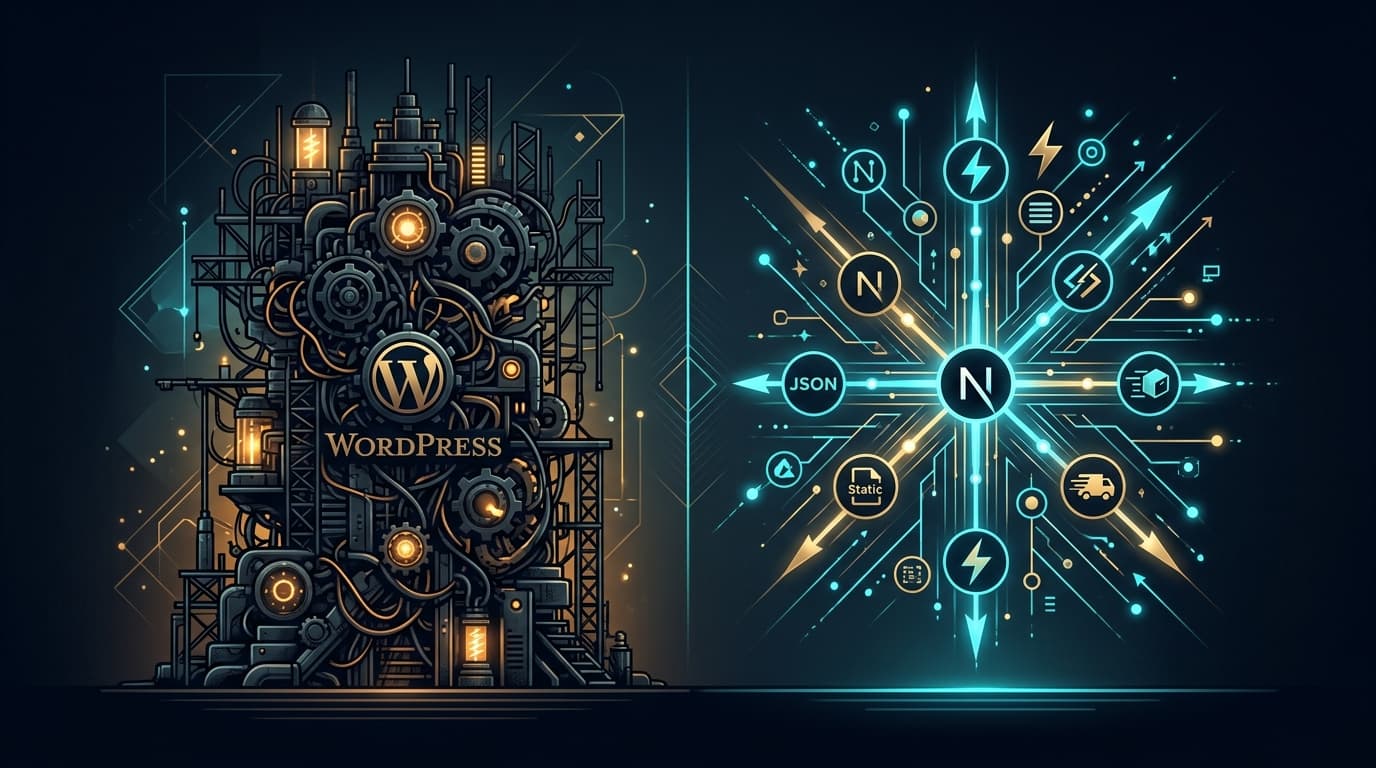
I've been building WordPress sites since 2010. I've built some genuinely good ones — complex WooCommerce setups, custom plugins, theme architectures that I'm still proud of.
I'm also not going to pretend WordPress is always the right tool anymore.
The Honest Case for WordPress
WordPress still makes sense for a lot of situations:
- You have a large team that needs a familiar CMS
- You need extensive plugin ecosystem (WooCommerce, membership tools, LMS platforms)
- Your client wants to manage content themselves without technical knowledge
- Budget constraints make the dev time difference significant
- You're building a site that's mostly informational with modest traffic
These are real considerations. WordPress powers 43% of the web for reasons, and most of those reasons are still valid.
Where WordPress Falls Short
The problem is performance. Not because WordPress is inherently slow — a well-optimised WordPress site can be fast. But because it's an opt-in performance model. You have to actively fight for speed against the defaults.
Every plugin adds overhead. The database query model doesn't scale elegantly. Server-side rendering on every request means server load is directly tied to traffic. And despite best efforts, most WordPress sites score mediocre Core Web Vitals.
What Next.js Actually Gives You
Next.js is a different model. Static generation means pages are pre-built at deploy time and served from a CDN — no database query, no server render. The user gets a file, not a computation.
For a marketing site, a portfolio, a blog: this is almost always the right architecture. Pages load in under a second. Lighthouse scores are high by default. You're not fighting the framework to be fast.
The developer experience is also genuinely better for complex requirements. TypeScript, server components, built-in image optimisation, incremental static regeneration — these aren't features you add, they're just how Next.js works.
My Actual Decision Process
I ask clients a simple question: do you need a CMS that non-developers can use, or do you need the fastest possible site with maximum flexibility?
If the answer is the former, WordPress is often still the right call. If it's the latter — or if the site is complex enough that a developer will be managing content anyway — Next.js wins.
For sonicpixel.io itself, Next.js was the only sensible choice. This site needs to be fast, flexible, and demonstrate what we build. It does all three.
The Hybrid Reality
The interesting space now is headless WordPress — WordPress as a CMS, Next.js (or similar) as the front end. You get the content management benefits of WordPress with the performance benefits of a modern framework.
We've built this for a couple of clients and it works well when you have the budget for it. It's not a universal solution, but it solves the core tension between CMS usability and front-end performance.
The bottom line: use the right tool. Know what each tool actually gives you. And don't let platform loyalty get in the way of building something genuinely good.